
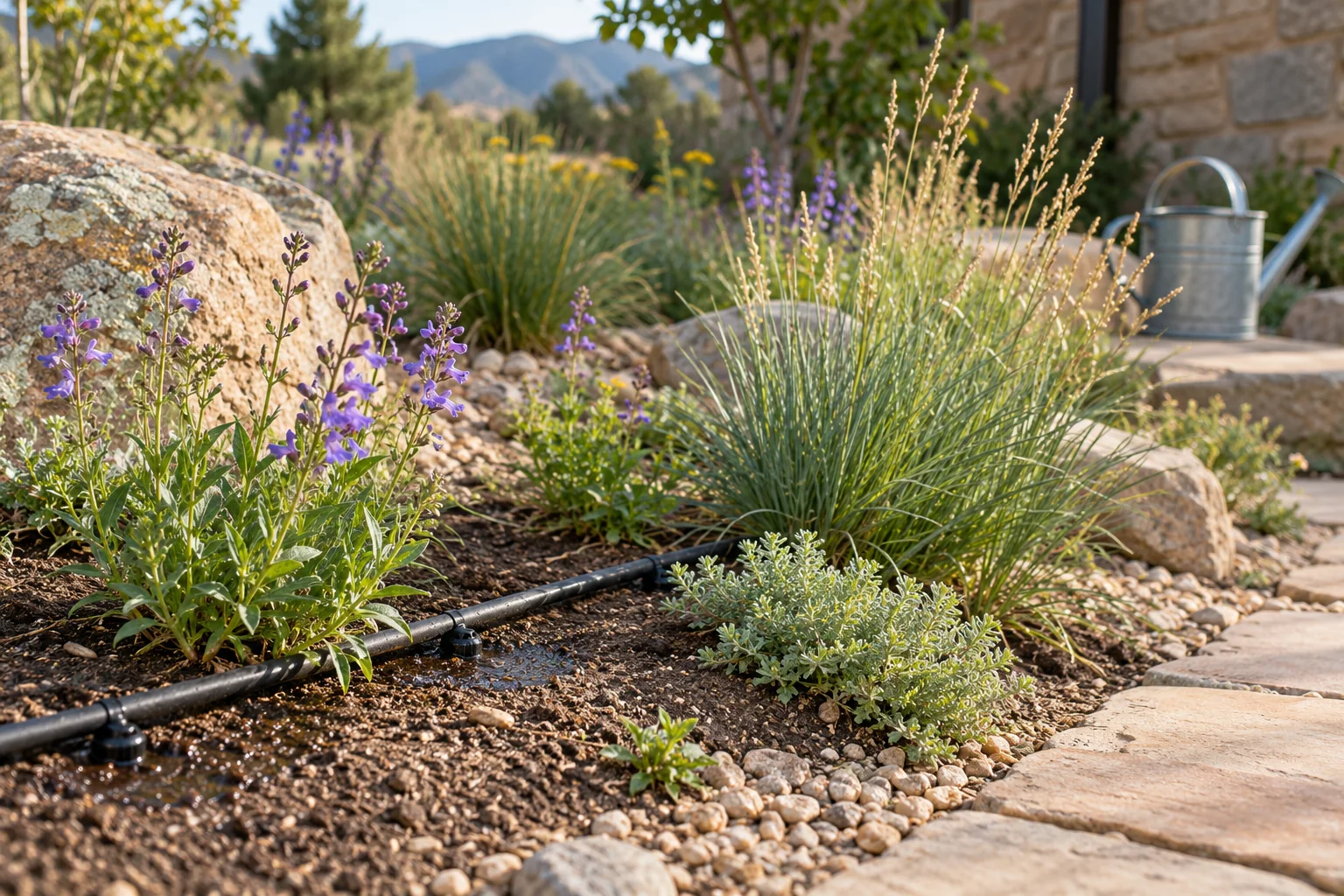
Do not confuse the future garden with its first summer
A mature dry-adapted garden and a newly installed one are different care situations. Plants arrive with limited root systems and have to establish in the surrounding ground. A low-water label describes an important characteristic, but it does not remove the need for appropriate care during that transition. CSU Extension’s retrofit guidance makes this distinction explicit for xeric planting.
Ask about establishment before ordering plants. Identify who checks moisture, how irrigation is adjusted and what happens when someone is away. This is part of the project, alongside the plant list and paving. A garden intended to become manageable over time still needs a realistic first-season commitment, particularly when installation coincides with hot, dry or windy conditions.
Map watering groups while the layout is flexible
Show plants with similar water needs together on the plan. Then consider differences in light, heat and wind exposure. A bed against a warm wall may behave differently from a sheltered border on the other side of the house. CSU Extension’s efficient-watering guidance connects irrigation zones to both the planting and the conditions, rather than treating the whole yard as one schedule.
Keep lawn, established trees and new planting visible as separate considerations. Existing pipework can influence what is convenient, but convenience alone should not set the design. If the system cannot support the proposed groups clearly, discuss the options with a qualified irrigation professional before the planting is installed. A simple understandable arrangement is easier to maintain and adjust.
Know what each control actually waters
Create a plain-language map of the irrigation system. Label the zones in a way that corresponds to recognizable garden areas, and keep it beside the controller instructions. Turn each zone on during a walkthrough and confirm that its reach matches the map. A control named only with a number becomes difficult to manage when the person who installed it is no longer present.
Watch for water on paths, missed plants and components that are difficult to access. In a drip system, verify the actual placement and operation of emitters rather than assume the presence of tubing proves every plant is served. Record the starting settings, but treat them as a starting point for review. Weather, plant development and maintenance can all require adjustments.
Observe the soil as well as the leaves
Leaf appearance alone can be an incomplete guide to what is happening below the surface. Learn an appropriate way to check moisture for the plants and soil in your garden, with advice from the installer or a local horticultural resource. Look at several representative positions, including areas that seem to behave differently. Record what you find rather than responding to every change by increasing the whole system.
Keep a simple notebook with the date, weather, irrigation changes and observations. If a plant struggles, that record can help someone give informed advice. It is more useful than trying to remember whether a bed received extra water last week. Persistent symptoms or unusual soil conditions deserve diagnosis; they should not become an endless sequence of untested controller changes.
Give new trees specific attention
A newly planted tree should not disappear into the general bed schedule. CSU Extension’s tree-establishment guidance focuses attention on the root ball and the development of roots into surrounding ground. Ask for instructions suited to the tree, planting conditions and irrigation method. Keep that plan with the plant record and identify who will check it during the establishment period.
Be careful when nearby landscape work changes. Removing turf, changing sprinkler coverage or adding a terrace can alter the care a tree receives. Discuss those effects before the system is modified. An existing tree may also need separate consideration from the new planting around it. A useful watering plan accounts for the living garden already present, as well as the new additions.
Review the plan as the garden develops
Put review dates on the calendar, then adjust them when weather or plant condition warrants attention. The purpose is to observe, not to enforce an identical routine regardless of conditions. Walk the garden while irrigation is running occasionally so leaks, blocked outlets or misdirected spray do not remain unnoticed. Check after work that might have moved a line or buried a component.
As plants establish, revisit the instructions with appropriate advice. Avoid assuming that every part of the garden moves to a reduced schedule at the same moment. A plant added later is in a different stage from the bed around it. Mark replacements on the plan and note the change in care so a small new root system is not overlooked within mature planting.
Plan for the seasons outside irrigation season
Winterization of equipment and the water needs of plants are related but distinct questions. In Colorado, dry periods outside the growing season can still matter. Use current local guidance for fall and winter plant care, and arrange appropriate professional service for equipment where needed. Do not make an improvised system adjustment simply because the weather has changed.
A good handover leaves you with a plant list, an irrigation map, operating instructions and a clear contact for questions. It also leaves you confident about what to observe. The strongest watering plan is not a promise that the garden will take care of itself; it is an understandable way to respond as the planting settles in and becomes the garden you intended.