
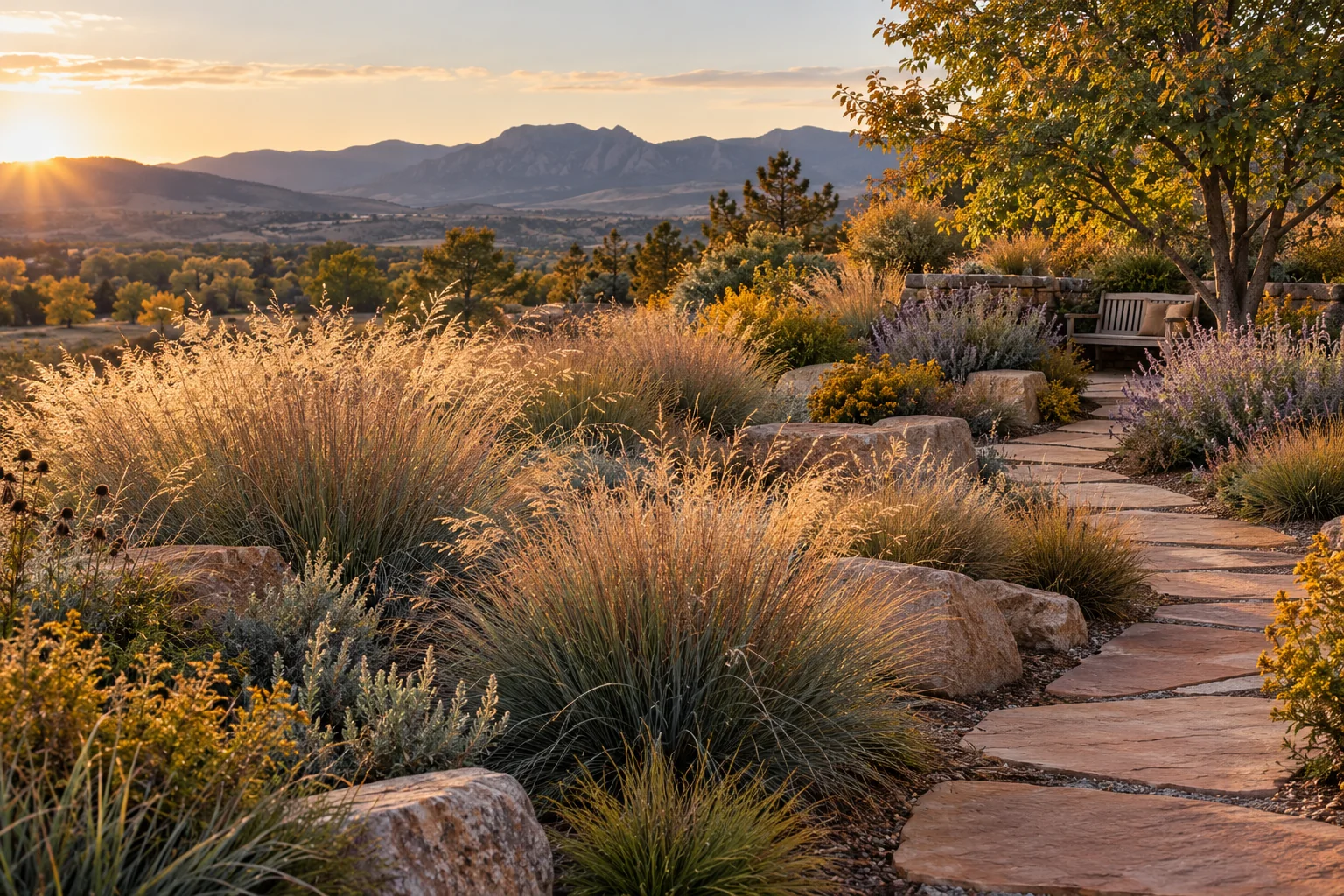
Look at the shape before the seed head
A grass can make a strong impression when its seed heads catch the light, but the plant needs a role during the rest of the year too. Begin with its overall form: a low tuft, an upright clump, a soft arch or a broad moving mass. Think about that form beside the path, wall and other plants. The most useful choice supports the composition before its most photogenic moment arrives.
Stand where you will normally see the planting. A grass viewed against the sky can feel very different from the same plant against a dark fence. Notice the background, distance and direction of light. These observations can tell you whether the garden needs a delicate edge, a repeated vertical accent or a more substantial group that holds its shape across the space.
Keep mature spread on the plan
Nursery pots make grasses easy to underestimate. Draw their expected mature spread and check the space around paths, seats and neighboring plants. A soft form may look inviting in an image but feel inconvenient when it arches into a narrow walk. Give the main route enough breathing room and use closer planting where people can choose to approach it.
Think about the plant’s habit as well as its size. Some grasses stay in distinct clumps; others can spread more widely. Verify the exact species and cultivated form before ordering. Ask about local suitability and maintenance, rather than selecting on a common name alone. A plant list should explain what you are putting in the ground and how it is expected to behave.
Choose for the conditions, not a general reputation
The category of ornamental grasses includes plants with different cultural needs. CSU Extension’s regional reference separates grasses for drier conditions from those suited to more moisture and notes variation in height, texture and water requirements. Use that distinction when building the palette. A grass is not automatically appropriate for a dry bed simply because other grasses perform well there.
Review the proposed position’s soil, drainage, light and irrigation. An exposed strip beside paving differs from a cool border under a canopy. Consider the mature trees and other planting sharing that ground. If the first grass you like does not fit, look for another plant that can provide a similar visual quality in conditions that are realistic for the garden.
Use repetition to connect separate places
Repeating a grass can link the entry, terrace and a more distant planted area without making each space identical. Keep the repetition deliberate. A clear group at a path junction and a smaller echo near a seat may establish a stronger relationship than scattering single plants evenly through every bed. Let the size of the space determine the scale of the group.
Test the plan in a simple way: cover the plant names and look at the shapes. Can you understand where the repeated forms lead the eye? Is there enough contrast for the other plants to have a role? A garden made entirely of the same fine texture can lose definition. A stronger branching form, a broader leaf or a quiet stone edge can give the grasses something to work against.
Plan flowering and foliage as a sequence
Look beyond a single autumn photograph. Ask when the grass begins to contribute, when its flowering stems appear and what remains later in the year. Coordinate that sequence with the perennials and shrubs around it. A border can have changing moments without requiring every plant to be conspicuous at once. Space for quieter periods often makes the strongest moments more enjoyable.
Keep a seasonal record as the planting establishes. Photograph the same group from the same position and note what is happening around it. If the bed feels empty at a particular time, consider the composition before adding another grass. The answer might be a different supporting layer or a stronger structural plant, rather than more of the element already present.
Make maintenance an intentional part of the design
Ask how and when each selected grass is normally maintained in your setting. Species, plant condition and local exposure can affect the answer. CSU Extension discusses the seasonal contribution of standing foliage and seed heads, but that does not mean every grass should remain untouched in every location. Gardens with fire considerations or specific plant-health issues need appropriate local advice.
Show maintenance access on the plan and keep plants clear of irrigation equipment that needs inspection. If someone else cares for the garden, label the grass groups and record the intended approach. Avoid treating all grassy-looking plants as interchangeable. An informed care plan helps retain the form you selected and prevents routine work from erasing the character of the border.
Let a limited palette do enough
It can be tempting to collect every grass with an interesting seed head. Instead, choose a few that perform different spatial jobs and let their relationships develop. A low repeated form along a path, a taller group against a boundary and a restrained perennial layer may be enough. The garden gains character from proportion and placement, not simply from the length of the plant list.
Bring photographs that show the qualities you like, then translate them into site-appropriate choices. Look for movement, light, texture and seasonal outline rather than an exact catalogue match. In a Colorado garden, grasses can make a compelling connection to the wider landscape while remaining part of a comfortable, carefully organized place to sit, walk and notice the seasons.