
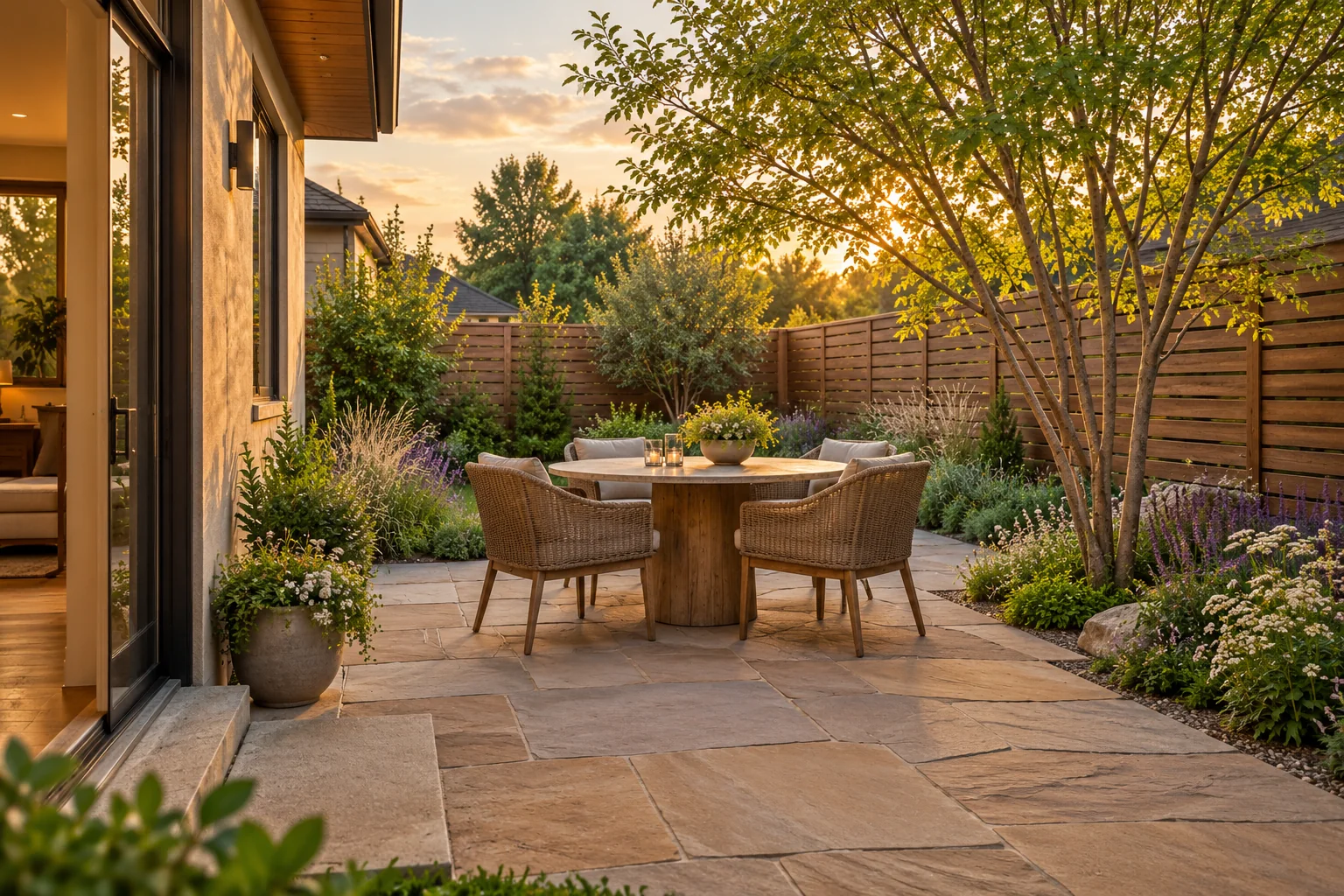
Begin with an ordinary evening
Before measuring a patio, describe an evening you would like to spend there. Perhaps you arrive home, put a drink on a small table and read for half an hour. Perhaps four people eat outside while someone moves between the kitchen and the grill. These scenes make a useful brief because they reveal the space people need. A photograph of a beautiful courtyard rarely tells you where a chair goes when someone stands up.
Choose a primary use and one or two supporting uses. In a small yard, giving every activity its own permanent area can leave none of them comfortable. A dining surface might also work for potting plants when the chairs are moved. A low bench can serve a quiet morning and a larger gathering. Aim for useful overlap while keeping everyday access straightforward.
Draw the room before choosing the furniture
Measure the boundary, doors, steps, window sills and anything that cannot move. Put those on a simple plan, then draw the furniture at its actual size. Include chairs in their occupied position, rather than tucked neatly under the table. Walk from the house to the gate on the drawing. If that route passes through the place someone needs to sit, the arrangement needs another pass.
Try the arrangement outside with movable furniture and a few lengths of rope. Keep it in place for several days if possible. Notice whether the afternoon sun hits the seat you expected to be shaded, whether the door opens freely and whether the route to storage remains clear. This inexpensive rehearsal can reveal a problem while changing the plan still means moving a chair.
Let one surface give the garden breathing room
A collection of tiny paving areas can make a compact garden feel fragmented. Consider one generous, coherent surface for the main activity and let planting shape its edge. This does not require paving the whole yard. A clear rectangle or an open curve can leave more room for substantial planting than a series of narrow borders around several competing surfaces.
Choose where to spend visual detail. An expressive stone landing beside quiet gravel may be enough. Repeating the same edge detail along a path and a planted border can connect the whole space. Bring samples outdoors before deciding: materials seen under a shop light can read very differently beside the house, particularly in the bright light and deep shade of a Colorado afternoon.
Use planting to define edges, not fill leftovers
Give a planted area a clear role. It might soften a fence, frame the seat or create an outlook from the kitchen. Choose that role before filling a narrow strip with a long shopping list. Repetition often helps: a few well-chosen plants in useful groups can make the boundary feel continuous while leaving enough space for each plant to develop.
CSU Extension’s perennial-gardening guidance puts site selection before plant selection. In a compact garden, translate that into a small map of light, exposure and irrigation. A border beside a hot wall may need a different palette from the bed under a tree only a few feet away. Coordinate mature spread with the furniture and paths so that planting supports the outdoor room as it grows.
Consider privacy from the place you sit
Privacy is experienced at eye level. Sit in the planned chair and identify the particular view that feels exposed. The answer may be a short screen in one position, rather than a tall enclosure around the entire boundary. A carefully placed shrub or an airy tree canopy can change the feeling of the room without making it gloomy or using all the planting space.
Test the effect from inside the house as well. A screen that improves the evening seat might block the view from a favorite window. Check local requirements and any applicable neighborhood rules before committing to a structure. Its height, footing, wind exposure and relationship to boundaries need to be resolved for the property, alongside the appearance of its timber or metalwork.
Make maintenance part of the drawing
A small garden still needs places for practical things. Decide where a hose can reach, where tools belong and how a person carries a bag of mulch without stepping through planting. Think about fallen leaves, furniture storage and the route a bin takes to the street. These details rarely appear in the inspiration image, but they shape whether the space stays pleasant to use.
Avoid solving storage by making the garden impossible to move through. A small freestanding cabinet may work better than a deep built-in bench if access is tight. Leave irrigation components reachable, and check that planting can be maintained from the paths. A tidy plan is most useful when its everyday routines are equally well considered.
Finish with a few strong decisions
A compact garden usually benefits from editing. Keep the seat that is comfortable, the route that makes sense and the planting that gives the room its character. Remove details that repeat a job already done. You may find that a single tree, a good table and a substantial border create a richer place than a longer list of features crowded into the same ground.
Bring a measured sketch, photographs from the house and your ordinary-evening brief to a design conversation. Include the limitations as well as the wishes: shade at a certain hour, a gate that must stay clear, furniture you intend to keep. Those specifics turn a small garden from an exercise in fitting things in into a place that comfortably supports your life.